

What Is Fiber Laser Cutting Heads?
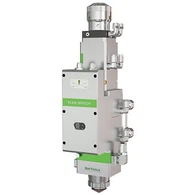
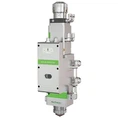
The laser cutting head is the core component of the metal fiber laser cutting machine. It is a laser output device, which consists of a nozzle, a focusing lens and a focus tracking system.
CNC laser cutter head mainly include 10 parts: optical fiber line, optical core, upper protective lens, collimating lens group, focusing lens group, middle protective lens, lower protective lens, ceramic body, nozzle, and focus.
Good beam quality
The smaller the cutting line is, the higher the processing efficiency is and the better the processing quality is;
Fast cutting speed
The fiber laser cutting heads is twice of the equal power co2 laser cutting machine;
High stability
Fiber laser cutting heads the service life of key components can reach 100000 hours;electro-optic conversion efficiency is very high.Optical fiber laser cutting machine is about 30%, three times of co2 laser cutting machine, energy saving and environmental protection;
Low operating cost
The power consumption of the whole machine is only 20-30% of that of the same co2 laser cutting machine;
Low maintenance cost
Optical fiber transmission, no reflector;basically free of maintenance, can save a lot of maintenance costs;
Simple operation
Optical fiber transmission, no need to adjust the optical path;after a simple training can be used, very convenient.

BM109: SERIES
Economical Medium and Low Power Automatic Focusing Cutting Head
Power Rate: 1.5KW

Autofocus Fiber Laser Cutting Heads
The collimating lens and focusing lens group have cooling structures, and the nozzle cooling air flow is increased at the same time,effectively protect the nozzle and ceramic body, and prolong the continuous working time.

Intelligent Laser Cutting Head
Light design, fast acceleration. At the same time, it has optimized optical configuration and smooth and efficient airflow design, significantly improving cutting quality and efficiency.

BM110: SERIES
Power Rate: 3.3KW
Medium power automatic focusing cutting head
Why Choose Us
Application fields
Since its establishment, the company has focused on laser industrial applications. We are committed to the sales and service of laser accessories, pneumatic components, and other mechanical accessories.
Customer service
Our company has more than 150 employees, professional production lines and service teams, which can efficiently complete machine production and assembly. We also provide 24-hour online service, which can promptly respond to your questions and give you feedback on the progress of your order.
High quality
Our products are manufactured or executed to very high standards, using the finest materials and manufacturing processes.
Advanced equipment
A machine, tool or instrument designed with advanced technology and functionality to perform highly specific tasks with greater precision, efficiency and reliability.
Types of Fiber Laser Cutting Heads
Planar fiber laser cutting head
The automatic focusing cutting head is suitable for the integration of large and medium-sized platform cutting machines. According to the selected laser power, it can cut 20mm large stainless steel, aluminum and 40mm large carbon steel with good cutting quality.
The plane fiber laser cutting head is extremely light and has a faster carrying speed. It is suitable for high-precision laser cutting and is widely used in fields with extremely high precision requirements such as the aviation industry.
Laser cutting head
The CO2 laser cutting head is the core component of the CO2 laser cutting machine, which mainly adopts laser CO2 cutting technology. The laser tube is generally driven by a laser power supply to emit light, and the light is refracted by several mirrors and transmitted to the laser head.


YAG solid laser cutting head
The YAG solid laser cutting speed is faster than CO2, which is more than 100 times the speed of wire cutting. The heat affected zone of the incision is small, it will not deform, the incision is smooth, and no subsequent treatment is required.
3D fiber laser cutting head
This cutting head is designed for robot 3D cutting and is suitable for cutting angle tubes, round tubes and 3D stamping parts. The 3D fiber laser cutting head has a compact cutting structure, light weight, reasonable water cooling distribution, focus rotation adjustment, built-in amplifier, gas path diffusion, elimination of swirl, and Laval nozzle cutting to make the cross section smoother and more vertical.
Metalworking
Fiber laser cutting heads are widely used in the metalworking industry to cut various types of metals, including stainless steel, carbon steel, aluminum, brass, and copper. They are used to produce sheet metal components, structural parts, chassis, brackets, gears, and other metal parts with precise shapes and sizes.
Automotive industry
Fiber laser cutting heads play a vital role in the automotive industry to cut metal sheets and tubes to manufacture automotive components such as body panels, frames, exhaust systems, engine components, and complex automotive parts with complex geometries.
Aerospace industry
Laser cutting technology is widely used in the aerospace industry to cut lightweight metals such as aluminum and titanium to produce aircraft parts, turbine blades, fuselage panels, structural parts, and other aerospace parts that require high precision and quality.
Electronic manufacturing
Fiber laser cutting heads are used in the electronics industry to cut thin metal sheets and pcbs (printed circuit boards) with complex patterns and fine details. They are used to manufacture electronic housings, casings, connectors, and other electronic components.
Signage and advertising
Fiber laser cutting heads are widely used in the signage and advertising industry to cut a variety of materials such as acrylic, plastic, wood, and metal to create custom signs, displays, logos, lettering, and decorative elements with high precision and intricate designs.
Architecture and interior design
Laser cutting technology is used in architecture and interior design applications to cut materials such as wood, acrylic, and metal to produce decorative panels, partitions, screens, wall art, furniture, and custom architectural elements with intricate patterns and designs.
Packaging industry
Fiber laser cutting heads are used in the packaging industry to cut cardboard, paperboard, and other packaging materials to create custom packaging solutions, prototypes, displays, and promotional materials with precise cuts and creases.
Medical device manufacturing
Laser cutting technology is used in the medical device industry to cut a variety of materials such as stainless steel, titanium, and polymers to produce surgical instruments, implants, medical devices, and components with complex geometries and high precision.
Components of Fiber Laser Cutting Heads
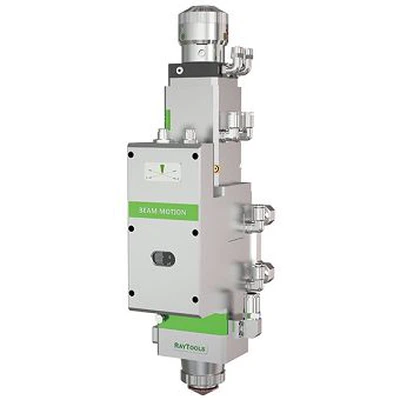

Laser delivery fibre
Right at the top (or side) of the head is the laser delivery fibre. This brings the beam from the laser resonator to head, via a length of glass fibre. At this point the beam is tiny. It's been compressed inside the resonator ready to be sent to the head through the fibre.
Collimation lens
The collimation lens expends the compressed beam from the laser delivery fibre, up to a usable size. When the beam leaves this optic its ready for delivery to the focusing lens. This optic is not user serviceable.
Focus or cutting lens
The focus or cutting lens takes the expanded beam and focuses it to a very small spot. This is generally focused on or into the work piece. The energy density of this spot is what allows the processing of materials with the laser. This optic is not user serviceable.
Focus adjustment drive
Most modern heads have a lens positioning system within them. These are generally servo controlled and are very accurate. These systems allow the focal position of the cutting lens to be placed very accurately on to the work piece, via the control system, and tech tables of the machine. This system is very fast in operation and makes switching cutting styles simple, and seamless for the operator.
Protective window or cover slide
It's very important to keep the optics mounted in the head completely clean and free of contamination. To this end, most modern heads contain protective window or cover slide to keep the cutting process isolated from the main optical components of the head. The protective window is relatively inexpensive when compared to the cutting or collimating lens and is consumable. The protective window is operator serviceable.
Assist gas cavity
The cutting process requires an assist gas. This gas is introduced through the assist gas inlet into the assist gas cavity, directly below the protective window. The gases in this cavity can be at extremely high pressure and are there to assist cutting.
Copper nozzle
The main function of the nozzle is to deliver a jet of gas to the cutting process in a controlled and stable manner. This relatively low-cost component is key to good processing. It must be kept in good condition and should be inspected frequently.
How to Maintain Fiber Laser Cutting Heads
Cutting head sealing
In order to prolong the service life of the cutting head, after the installation and commissioning of the equipment, the upper part of the cutting head can be sealed with masking tape.
Calibrate laser to the center the nozzle
Check whether the laser is emitted from the center of the nozzle before use every day. If not, please calibrate again and adjust the laser to the center of the nozzle.
If the light is not in the center, it will cause unstable cutting and generate burrs on the edge.
The adjustment method is to a stick transparent tape on the light outlet of the nozzle, and then emit the laser to see if the spots are offset, remove the transparent glue, as shown in below figure.
Check ceramic ring and the nozzle
Check the roundness and cleanliness of the ceramic ring and the nozzle before each cutting. If there is foreign matter, clean it with a cotton swab and isopropyl alcohol.
Check the protective lens
Check the protective lens to see if it is dirty or if water mist appears. Use a cotton swab dipped in isopropyl alcohol or analytically pure (more than 99.5%) to wipe it, make sure there is no trace of water.
How to Choose a Fiber Laser Cutting Heads
Cutting thickness
Different types of cutting heads offer varying levels of cutting thickness. Therefore, you need to be absolutely sure about the thickness of the materials you need to cut. This helps ensure you get the right specification for your laser cutter.
Cutting speed
Just like cutting thickness, cutting heads also come with varying specifications for cutting speeds. Here again, you need to ensure you get the right cutting speed that your cutting material requires or can handle.
Precision and accuracy
Some cutting heads, like the auto-focusing one discussed above, offer greater precision and accuracy than others. It is up to you; your cutting needs to determine your required precision level. Once you know that, you can invest in the right type of cutting head. This also can take a few trials before you get to the perfect cutting head for your laser cutter.
Material type
As cutting heads come in different types, they aren't all suitable for every material out there. Hence, it would be best if you cross-check whether the cutting head you are getting is suitable to cut through the material you need to work on.
Maintenance
It is an important factor because while some cutting heads, such as the fixed focal one, require minimal maintenance, a capacitive sensor cutting head requires high maintenance. Therefore, keep this in one because maintenance directly impacts the lifespan of the cutting head.
Cost
Obviously, any business decision is finally driven by the cost. You need to get a product that falls within your budget. Hence, go out and thoroughly research the prices and the features they offer. Don't pay a higher price for features you don't need. Stick to the requirements and also keep future expansion plans in mind.
A fiber laser cutting head operates based on the principles of fiber laser technology and precise optics. It generally uses a high-powered fiber laser source to generate a concentrated laser beam. Then, it delivers and focuses the laser beam onto the workpiece. The interaction between the laser beam and the material provides controlled material cutting. In the following, we will discuss the step-by-step explanation of the cutting process.
First, the fiber laser source generates a specific wavelength and power laser beam. The fiber laser cutting machine transfers this laser beam through an optical fiber to the fiber laser cutting head. Second, the beam delivery system guides the laser beam from the source to the cutting head. In this case, comprising mirrors and optical fibers play a crucial role. And then, the collimating unit of the laser cutting head shapes and aligns the laser beam. In this case, the focusing lens concentrates the laser beam to a small spot size.
Third, interacting with the material, the focused laser beam strikes the workpiece. The high energy density of the laser beam rapidly heats and vaporizes the material at the focal point. It enables controlled melting, burning, or vaporization. However, the precise movement of the laser cutting head determines the shape and dimensions of the cut. After that, the nozzle of the fiber laser head delivers oxygen or nitrogen to the cutting area. This gas blows away molten material and debris from the kerf. It also cools the workpiece and prevents excessive heat-affected zones. Finally, you can observe real-time device monitoring using the fiber laser cutting head sensors.
Safety Precautions When Using the Fiber Laser Cutting Heads
Learn your machine
First off know your machine. Read and understand the maintenance manual for the machine, chiller, power source, dust collector and any other components and accessories connected to or running from the laser cutting system.
Know the source
It's important to know that many items have their own power source and although you may have shut off the machines power, the chiller may still electrified. Know where all circuit cut-off breakers are and how to properly lock them in a safe position.
Know its done
Make sure the fiber laser machine has completed all motion before attempting any kind of maintenance as sometimes there are pauses in a program, such as shuttle table motions that may not be visible from the operations area.
Don't bypass the doors!
When setting up and during normal operation it is very easy for operators to want to bypass the door switches in order to operate the machine with the front or loading doors open. If these door locks are bypassed on your fiber laser machine, your operator and surrounding staff will be exposed to not only the class-1 fiber laser light (which can blind!) but possible loose parts ejected from the machine during a rapid move. Further, anyone accidentally entering the motion zone can be pinched or crushed as the nature of fiber laser cutting systems is to process material very fast and thus have exceedingly high rapid speeds.
Wear your safety glasses
Never before in laser cutting systems has the light source been so intense and powerful then in fiber laser cutting machines. These lasers are typically guarded by solid cabin designs and expensive green glass protecting the operator and surrounding work area from flashes and eye burn. When maintaining your fiber laser make sure you take precautions by wearing your class-1 laser light approved safety glasses as well as any other recommended safety gear.
Chill out
Maintain your chiller properly by checking fans, fluid levels in it and ensuring the filters are clean and clear per your manufacturer's recommendation. It is also imperative to ensure the chiller is running and cooling prior to turning the solid state fiber laser resonator on, as a cooling source must be in place. These fiber laser power sources/resonators generate an enormous amount of heat during their normal operation that must be removed by the chilling process. A dirty or damaged chiller can cost tens of thousands in repairs to a damaged fiber laser resonator if not properly maintained.
Steady hands
When maintaining components of the fiber laser do not mishandle or drop them. There are very finely tuned and aligned components including optics within the laser system that can be easily damaged or destroyed by an inadvertent drop. Use an extra precaution when maintaining these sensitive components.
Keep it straight
Although the fiber optic cable is flexible by design, it is not meant to be wound tightly or coiled up like an old extension cord. Remember that inside the shielded larger "cord" like cable is a glass optic that can be fractured or broken which will greatly affect your fiber laser machines cutting performance. Also these cables require special equipment and a clean environment to be replaced so it is with an extra precaution that you should be handling them.
Don't remove it!
Never remove the fiber cable from the cutting head or the laser power source. These areas are very suspect to even the slightest bit of dust and therefore should only be disassembled by a factory trained technician with the proper tools to maintain the head and cable connections cleanliness.
Clear the area
Make sure the area is clear around the machine when operating it and the shuttle table or loading system. In some cases it is easy for workers to slip inside light guard protected areas during non operation to retrieve material, scrap etc and this be in a hazardous zone, unprotected when these components are then put into action.
Carefully position the fiber laser cutting head in the designated mounting location on the machine. Now, securely attach the laser cutting head to the device. In this case, you must use the appropriate mounting hardware. Follow the manufacturer's instructions for more information. Make sure the cutting head is securely fixed in place. It is necessary to prevent any vibration or misalignment during operation.
Now align the laser cutting head with the machine. In this case, use a precision alignment tool or a laser alignment device.
Connect the fiber optic cable from the laser source to the fiber input of the laser cutting head. Make sure the connection is secure and correct. Check the electrical wires, gas pipes, and auxiliary gas and cooling lines.
Finally, start the fiber laser cutting machine according to the manufacturer's instructions. Perform initial testing and calibration procedures. Make any necessary adjustments to ensure accurate and precise cutting.
Company Introduction

Jinan Chaoqian Machinery Technology Co., Ltd. was established in 2019, located in Jinan, Shandong Province. Since its establishment, the company has focused on laser industrial applications,we are committed to the sales and service of laser accessories, pneumatic components and other mechanical accessories.
FAQ
Hot Tags: fiber laser cutting heads, China fiber laser cutting heads manufacturers, suppliers, factory, Laser Cutting Head with Fiber Interfaces, Fiber Laser Accessories, energy efficient laser cutting head, Laser Cutting Control System, Rail Type Cylinder, Handheld Laser Welding Heads